
Process Design |
|
|
|
We have designed both our filling concept and line very variable to permit us to adapt to customers’ needs and requests. This starts with raw materials: the customer determines specifications and Transcoject uses the raw materials to prepare the solution and fill it into to the agreed containers. When necessary, Transcoject will develop and validate a specific filling process, tailored to the properties of the medium. Designing the process means identifying (and defining) the ideal filling parameters, such as stirring time and choice of filters. Thanks to our vast flexibility, we produce varying batch sizes, from the small series up to larger batches of up to 200 litres, in manual or semi-automatic filling. Working on 2 shifts, we plan and perform production campaigns ideally suited to your article. As regards the containers to be filled, we are just as flexible: almost anything goes, from small syringes or vials up to syringes of 50ml volume. |
|
Filling Procedure |
|
|
|
PROCESS AND TECHNIQUE |
||
|
The process of aseptic filling where a sterile product is filled into medical containers without the need for further terminal sterilization is a particularly critical process that Transcoject has operated successfully for years. Accordingly, Transcoject is certified according to ISO 13408 for aseptic filling. Qualified rooms and machinery as well as validated processes guarantee a safe product. We regularly review the quality and safety of the filling process by validating the procedure by means of integrated Media Fills that meet current GMP requirements. At the core of our filling area is a laminar flow enclosure according to cleanroom class A, surrounded by a class B cleanroom. This enclosure is where we fill medical devices up to class III. At present, amongst others, we are filling syringes with urology products, in particular Gepan® Instill for Pohl Boskamp as well as Instillamed® for Farco Pharma (Klosterfrau group) Sterile filtration of media makes sense – and is equally safe – when heat sterilization is not feasible. In general, the filtration is effected using filters of a pore size of 0,2µm which reliably retain animate cells while allowing the dissolved ingredients of the medium to pass the filter without undergoing any transformation. Sterile filtration is a gentle treatment of media, i.e. active ingredients and auxiliary substances are not exposed to radiation or heat. Having in-house laboratories for incoming and outgoing inspection allows us to perform nearly all relevant tests at short notice, whether raw materials or finished products. For example, we perform the following tests: |
||
 |
bioburden | |
|
osmolalität | |
|
viscosity | |
|
proportion of decisive integredients | |
|
pH value | |
|
endotoxins | |
|
Those tests that we cannot perform on our premises are assigned to certified external laboratories. |
||
|
ASSURE AN ASEPTIC AREA |
||
|
The filling runs are executed with dedicated equipment. All components that are in direct contact with the prodct are made of pharmaceutical-grade stainless steel and are sterilized regularly prior to any new filling run. Particular elements such as filters or tubes are exchanged before commencing a new production campaign. Cleaning programmes describe the process in detail, designate the cleaning agents as well as disinfectants and define the time frame. All this is strictly controlled and recorded in protocols. For every batch, an individual ambient conditions monitoring is conducted, including air, surfaces and personnel. According to our zoning concept, every single step is regulated, from gowning of the specifically trained personnel and inward transfer of the materials, all via diverse air locks, up to the production area sensu stricto. It goes without saying that the basic microbial load of the primary chemical material is of crucial importance for the aseptic filling. Therefore, our incoming inspection checks incoming base chemicals meet the specified threshold.
|
||
| next | ||
Filling |
|
||
|
COMPLEX PROCESSES, MADE-TO_ORDER |
|||
|
The filling of medical-pharmaceutical products is one of our most important divisions. As a full-service provider who contributes to peoples’ well-being, we naturally set high quality and safety standards in filling, as well as in all other divisions of our company. The aseptic filling, by which a sterile product is filled into vessels without the need for further terminal sterilisation, is a particularly critical process that not only requires qualified systems but also an extremely thorough validation of the aseptic conditions throughout the entire filling process. At Transcoject, we have successfully carried through this process for a number of years. In order to cater to the needs of our customers, we have designed both our concept and our equipment to be as adaptable as possible; this enables us to develop individualised processes. |
|||
|
Filling Procedure | ||
|
Process Design | ||
Features & Innovations |
 _______________________________ CONTACT R&D: Mr. Marg Tel. +49 4321 885 832 _______________________________ |
|||||||
|
Modular Syringes | |||||||
|
Staked Neelde-Syringe | |||||||
|
Swivel Nut | |||||||
| MODULAR SYRINGE | ||||||||
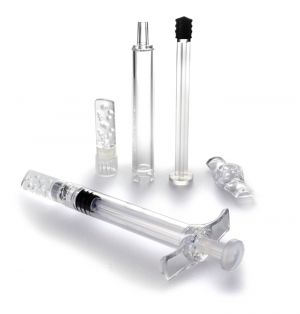 |
Transcoject has designed a modular syringe concept which generates the possibility for simple modifications of non-fluid path elements, both functional and design elements. The syringe consists of the following components: | |||||||
|
Basic syringe body with Luer cone. | |||||||
|
Luer-Lock respectively a tamper-evident closure with integrated Lock or a customised end piece, any of these affixed by ultrasonic-welding |
|||||||
|
Clip-on finger plate including backstop |
|||||||
|
Plunger assembly | |||||||
|
1ml long and 50ml have been developed to a degree that they are just short of readiness for start of production. They are very well suited for individual design adaptations of syringes in order to attain functional and article differentiation. For example, for cosmetic application, it would be easily feasible to permanently affix sponges or functional elements for the distribution of gels or spray nozzles as Luer extensions. |
||||||||
| STAKED NEEDLE-SYRINGE |
||||||||
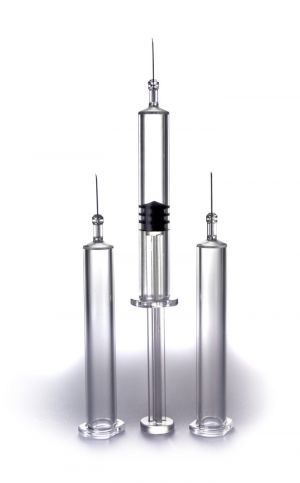 |
In a pilot project with further partners, Transcoject has developed a 1ml long staked-needle syringe made of COP that is tungsten-free. In such a staked-needle syringe, the cannula is firmly enclosed by the plastic material, which renders the use of glue unnecessary. Therefore, there cannot be any contact between the agent of the medical drug and glue. In glass syringes, however, such contamination by glue is frequent. The absence of glue in our staked-needle syringe comes as a major advantage, in particular considering the stability of complex molecules, such as proteins. In a further step, these syringes can be equipped with a needle shield or a tamper-evident closure; they can be delivered in nest and tub and ready to fill. |
|||||||
| SWIVEL NUT |
||||||||
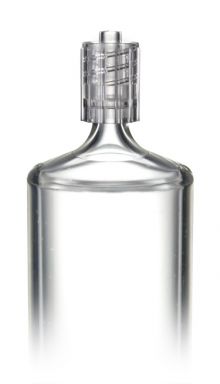 |
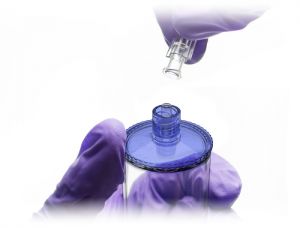
When using transfer tubing systems on a fix Luer Lock connection, the connecting tube builds up auto-torsion forces due to the fact that the connector is rotated. This force permanently effects the connection, causing the risk that the tube might disengage, thus creating a leak in the connection or even causing microbial contamination of the infused medication. This risk rises if liquid is present at the connecting lock. By using a swivel nut, the auto-torsion is avoided while the connector holds well. Nonetheless, even such a connection could disengage under particular conditions, namely the application of solutions under high pressure (contrast media, high-viscosity nutrition solutions). Transcoject has solved this problem by developing a connection (patent pending) where the swivel nut is interlocked withthe syringe, reliably assuring that the connection will not disengage unintentionally.
|
|||||||
 |
||||||||
Syringe Cartrigdes |
_______________________________ CONTACT R&D : Mr. Marg Tel. +49 4321 885 832 _______________________________ |
|||
| PLASTIC INSTEAD OF BROKEN GLASS | ||||
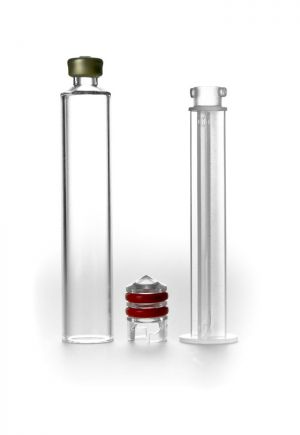 |
Syringe cartridges (cylindrical syringe ampoules) made from glass are a widely spread primary packaging, in particular used for anaesthetics in the dental field, but also employed in autoinjectors and pen systems. A well-known disadvantage of this packaging material, however, is breakage and bursting happening in the filling lines – and it is even more concerning when it happens in autoinjectors, where momentarily, extremely high pressure is exerted on the cartridge. Syringe cartridges made from plastic eliminate these problems, provided that the plastic material and the design are optimised for the appropriate pressure stability. In this context, Transcoject has developed a transfer device which serves to comfortably transfer the pharmaceutical solution from a bottle or vial into a syringe cartridge. A dedicated bayonet-connector stopper in combination with a corresponding piston allows the user to draw the medicine from a vial just like he would when using a syringe and, once the piston has been removed from the bayonet connector, the syringe cartridge can easily be inserted into the autoinjector or pen. This innovation and further adapted components make the reconstitution of lyophilised pharmaceutical preparation and the transfer of the reconstituted medication into the syringe cartridge easy and safe. We can also provide the single-use cannulas typically used in connection with syringe cartridges. |
|||
| next | ||||